
— and Why the West Should Accept It
An evidence-graded argument. Documented facts are sourced; contested claims are flagged as contested; the strongest counterarguments are presented before they are answered.
The moment
Every serious argument about a government-in-exile begins with timing, because history is unforgiving about premature ones. Consider what has changed in eighteen months:
- The war. Israel struck Iran in June 2025; the United States joined strikes in early 2026. Ali Khamenei was an early casualty of the war, and the question of who actually exercises authority in Tehran remains unresolved — the “Ghost Supreme Leader” problem, where documents are published in Mojtaba Khamenei’s name while he has not been verifiably seen. (Documented: absence timeline; Contested: his actual condition.)
- The January massacre. The regime’s crackdown on the January 2026 protests, with an internet blackout that became the longest in the Islamic Republic’s history, stripped away whatever domestic legitimacy remained. Casualty figures are contested — opposition estimates run far above the official toll — but the scale of killing is not seriously disputed.
- The 9% figure. The leaked internal “What Iran Wants” report (published by IranWire, July 2026) found roughly 9% support for the status quo. (Documented as a leak; treat the polling methodology as unverifiable — but note it is the regime’s own commissioned research, not opposition polling.)
- The diplomatic collapse. The Islamabad MOU is dead; Iran formally exited in July 2026 after the IRGC attacked shipping in the Strait of Hormuz during the negotiating pause. The “deal with the regime” track has been tried, in real time, and the regime torched it.
This is not 2009, when a government-in-exile would have been a diaspora fantasy grafted onto a regime with functioning institutions. The state’s legitimacy has collapsed by its own internal measurement; its supreme leadership is a signature without a verifiable signatory; and Western governments are actively drafting post-regime frameworks. The question is no longer whether an alternative structure will exist, but whether it will be coherent, Iranian-led, and formed before the collapse — or improvised after it.
What is actually being proposed
Precision matters here, because critics attack a strawman. The proposal is not “the West crowns a king.” It is:
- Pahlavi formalises the transitional structure he has already described — capable individuals identified inside and outside Iran, a 100-day transition framework, a constitution drafted and ratified by referendum, free elections under international oversight, after which the transitional government dissolves (his stated formula, February 2026).
- Western governments extend conditional recognition to that body as the legitimate interlocutor for the Iranian people — conditioned explicitly on the referendum commitment, coalition breadth, and human-rights guarantees.
- Recognition unlocks the practical machinery: diplomatic channels, claims on frozen assets and embassy properties, sanctions coordination, communications support (the Starlink model, already deployed at scale), and a legal address for defecting officials and diplomats.
The monarchy question is deliberately left to Iranians. That is the design, not a loophole.
What “acceptance” legally means — and which rung to argue for
“Recognition” is not one act; it is a ladder, and specifying the rung is what separates a policy proposal from a slogan. International legal practice (systematised in Stefan Talmon’s Oxford monograph on recognition of governments-in-exile, and visible in the Libya 2011 case study) runs roughly:
- “A legitimate political interlocutor” — political language with no legal effect; a partner for talks. Cost-free, and several Western states used exactly this vague formula for Libya’s NTC while officially maintaining that they “recognise states, not governments.”
- “The legitimate representative(s) of the [Iranian] people” — the formula applied to Libya’s NTC and Syria’s National Coalition. Politically potent, legally ambiguous by design.
- De jure recognition as the government of Iran — full legal recognition, with embassy rights, treaty capacity, and standing to claim state assets.
The legal obstacle to rung three is real and should be stated, not hidden: the baseline criterion in international law for recognising a government is effective control of territory, and recognising a body with none is classically “premature recognition” — which scholarship (Lauterpacht’s classic treatment; the Oxford analyses) treats as a potential breach of the non-intervention principle and even an internationally wrongful act. The recognised carve-out — continuing to recognise a government-in-exile — traditionally applies to incumbent governments driven out by foreign occupation (Norway, the Netherlands, Kuwait), not to oppositions.
The argument, therefore, is for rung two, structured to earn rung three. “Legitimate representative of the Iranian people” requires no territory, has abundant recent state practice behind it, and — as the Libya case showed — recognition at this level can itself be constitutive: the NTC accumulated governmenthood partly through the recognition cascade, before it controlled the country. Rung three transfers automatically at the moment of effective control on the ground. Precision here also disarms a whole class of objections: nobody is proposing that France accredit an ambassador from a Potomac townhouse next month.
The legal-continuity card (contested, but stronger than critics admit)
There is a second legal track, unique to the Iranian case among modern oppositions. The 1906 Constitution — Iran’s founding constitutional document, whose Articles 36–38 vest the constitutional monarchy in a defined line of succession (amended in 1925 to the Pahlavi line) — was never lawfully amended out of existence by its own procedures. As the scholarly literature on the Constitutional Revolution notes, the Mashrutih constitutional order formally existed until 11 February 1979, the day the Imperial Army declared neutrality and Shapour Bakhtiar — the last prime minister sworn in under its provisions — fell; it was extinguished by revolutionary fiat, not constitutional process. Bakhtiar’s own exile movement (the NRMI) made restoration of the 1906 constitution “as its original drafters intended — a Shah who reigns rather than rules” its formal platform, which matters because Bakhtiar was a National Front liberal, not a courtier.
Grade this claim honestly: revolutions extinguish prior constitutional orders as a matter of effectiveness, and no serious international lawyer would say the 1906 constitution binds third states today. But that is not the argument’s function. Its function is to place the Iranian case closer to the Norwegian/Dutch continuity precedents than any modern opposition can manage — a recognised body can plausibly present itself not as a new invention but as the resumption of a suspended constitutional order, with the referendum then deciding whether that order continues or a republic replaces it. It is a framing asset and a legitimacy bridge for regime jurists and officers looking for a lawful exit, not a courtroom claim.
The case for
1. A focal point already exists; refusing to formalise it doesn’t make it disappear.Pahlavi has the highest name recognition and the strongest measured support of any named opposition figure. The source is GAMAAN — the Netherlands-registered survey institute directed by Tilburg University’s Ammar Maleki, the only outfit that systematically measures Iranian opinion at scale. Its 2022 survey found Pahlavi the most popular figure on a list of civil and political leaders at 39%, more than double the next-named figure; a June survey of over 31,000 respondents found roughly 48% viewing him favourably (per Maleki to Reuters); and GAMAAN’s 2026 post-war report found that his call to protest was cited as a motivator by about 55% of respondents — behind only opposition to the Islamic Republic itself and economic grievance as a driver of the January uprising.
Methodology, stated honestly: GAMAAN polls online, calibrated to Iran’s literate adult population (roughly 85–90% of adults), because face-to-face polling under a police state produces preference falsification, not data. Online sampling has known limits — but it is the best instrument that exists, and its internal consistency across 2022–2026 waves is strong. Three GAMAAN findings cut against the case and belong in any honest account: his support drops below 20% in Kurdistan and the Azerbaijan provinces; his favourability declined about four points net after the war (roughly 8% moved from support to opposition, 4% the other way); and Maleki’s own topline conclusion is that no figure currently commands majority support. GAMAAN’s stable structural finding: roughly one-third strongly support him, one-third strongly oppose, one-third movable. The argument for a focal point rests on that first and third segments — not on a fictitious consensus. But the street evidence is convergent: protesters inside Iran carried his image in Tehran in January 2026 at documented personal risk. Masked demonstrators holding a photograph under a regime that shoots protesters is a costlier signal than any online poll. No other figure generates that signal. Coordination problems are solved by focal points, and this one is not manufacturable — it either exists or it doesn’t.
2. The alternative to an organised transition is not a better transition. It is chaos — or the IRGC.The most likely rival to a recognised transitional structure is not a perfect pluralist coalition; it is a military junta rebranding itself, a fragmented civil conflict, or a vacuum that neighbouring powers fill. Western planners’ three stated fears — prolonged chaos in a nuclear-threshold state, state collapse, and uncontrolled succession — are precisely what a pre-built, internationally recognised framework mitigates. “Regime collapse and hope for the best” is not a policy.
3. Policy alignment is real and rare.Pahlavi’s stated positions — secular constitutional governance, no nuclear weapons programme, recognition of Israel (he visited in 2023), ending proxy warfare, economic reintegration — align with Western security interests more completely than any other organised Iranian current. This is not a reason to impose him; it is a reason the West loses nothing and gains enormously by accepting a structure Iranians are already building around him.
4. Recognition changes behaviour inside the system.A government-in-exile with legal standing gives regime officials, diplomats, and mid-level IRGC officers something concrete to defect to — amnesty frameworks, guaranteed process, a future. The Polish underground state and Free France both functioned as defection magnets. Right now a wavering Iranian ambassador has nowhere to take his loyalty. That is a Western policy failure, and it is fixable with a signature.
5. The infrastructure is further along than critics admit.The Iran Freedom Congress convened in 2026 with working groups on transition governance, security, economy, ethnic and religious groups, women and youth — and members of its own presidium describe the goal as a government-in-exile (“otherwise, there would be no reason to form such a congress” — Kambiz Ghafouri, IFC presidium, to Foreign Policy). A 28-member National Reconciliation Council framework has been drafted. This is no longer a Twitter opposition. It is a coalition architecture waiting for a legal roof.
The case against — taken seriously
An argument that hides its weaknesses convinces no one. Four objections have real force.
“Popularity is not command-and-control.” Correct. Pahlavi claims contact with cell leaders across a thousand-plus labour, academic, and ethnic organisations inside Iran; that claim is asserted, not independently verifiable. Street chants do not run ministries. Answer: this is an argument for building the structure now, under scrutiny, with named personnel and transparent processes — not for waiting until collapse day to discover the gap. Governing capacity is constructed, and a recognised body can construct it; a hashtag cannot.
“He is polarising: republicans, leftists, and ethnic minorities object.” Also correct, and the Times of Israel’s critique lands on the sharpest point: his transition blueprint concentrates significant temporary power in his hands (“leader of the national uprising,” veto rights over transitional institutions) and is silent on federalism demands from Kurdish, Azeri, and Baluch communities. The NCRI/MEK rejects him outright — though the MEK’s own domestic standing is arguably negative, and its “3,000 parliamentarians endorse us” recognition campaign demonstrates the danger of the wrong body claiming the exile-government mantle first. Answer: the polarisation objection is the strongest reason recognition must be conditional: broad-based cabinet, minority representation with real portfolios, veto powers sunset-claused, referendum date fixed. The West’s leverage to demand this exists only before recognition. Withhold recognition forever and you keep the polarisation while discarding the leverage.
“It will look like 1953 again — foreign imposition.” The regime will make this argument regardless of what the West does; it currently calls unarmed teenagers foreign agents. The propaganda cost is priced in. What actually determines the imposition narrative’s traction is sequencing: recognition that follows visible Iranian demand (protesters carrying his image under fire) and is conditioned on an Iranian referendum reads very differently from a Langley organogram. The 1953 analogy fails on its own terms — Mossadegh was an elected sitting prime minister removed by covert action; this is recognition of an opposition to a regime whose own research shows 9% support.
“Exile governments without leverage fail — you get Dharamsala, not Paris 1944.” This is the decisive historical objection, and it must be answered structurally, not rhetorically. So answer it structurally:
What separates Free France from Dharamsala — and where this case sits
Governments-in-exile succeed under three conditions, and fail without them. Run the five cases against each:
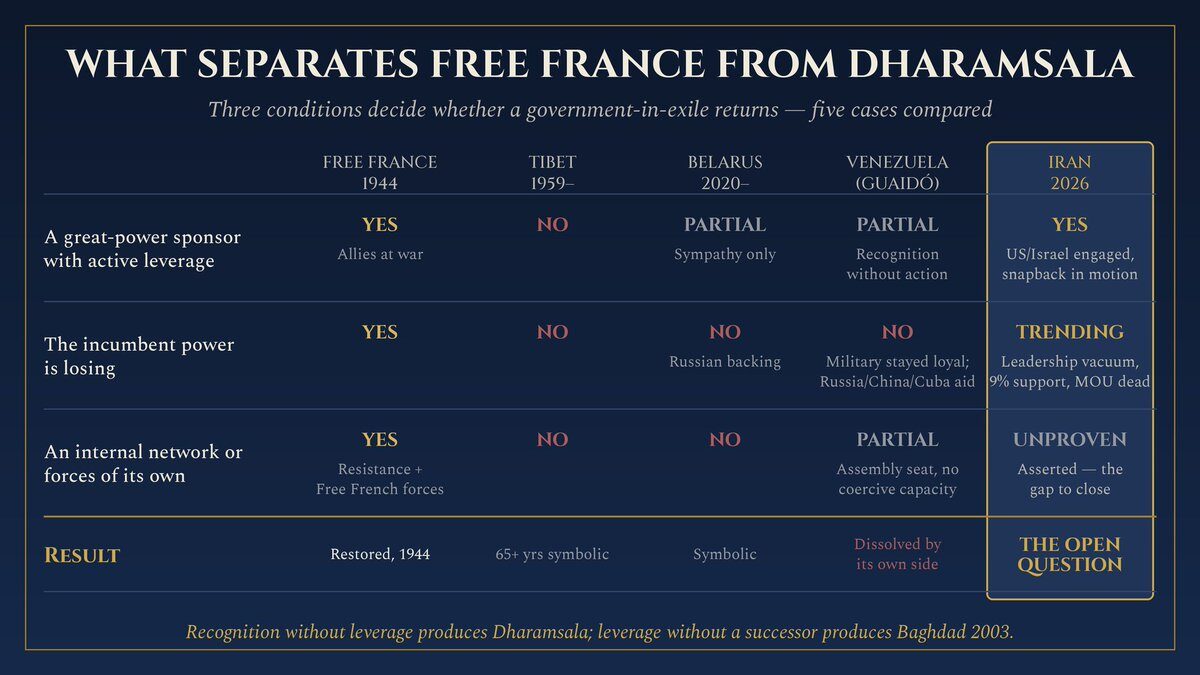
Condition 1 — A great-power sponsor with active leverage.
Free France 1944: yes — the Allies, at war.
Tibet: no.
Belarus (Tsikhanouskaya): sympathy only.
Venezuela (Guaidó): recognition without action.
Iran 2026: yes — the US and Israel militarily engaged, snapback machinery in motion.
Condition 2 — The incumbent power is losing.
Free France: yes.
Tibet: no. Belarus: no — Russian backing held.
Venezuela: no — the military stayed loyal and the economy stabilised via Russia, China and Cuba.
Iran 2026: contested but trending — a leadership vacuum, 9% measured support, the MOU collapse, economic strangulation.
Condition 3 — An internal network or forces of its own.
Free France: yes — the Resistance and Free French forces.
Tibet: no. Belarus: no.
Venezuela: an assembly seat, no coercive capacity.
Iran 2026: asserted, unverified — the gap to close.
The Guaidó test — the objection that must be answered first
Any critic worth engaging will lead with Venezuela, and they will be right to: it is the most recent, most Western-backed recognition experiment, and it failed completely. In January 2019 roughly 60 states, led by the United States, recognised Juan Guaidó as interim president. Four years later the opposition’s own National Assembly voted (72–23) to dissolve his interim government; by January 2023 the US State Department confirmed it no longer recognised him, and Maduro remains in the Miraflores Palace today.
The autopsy matters more than the headline, because each cause of death maps onto a condition the Iranian case must contract against:
- Recognition substituted for leverage instead of accompanying it. Washington recognised Guaidó and then applied sanctions — but never the coercive pressure that would change the military’s calculus. The April 2019 uprising collapsed precisely at that seam: plotters needed the Supreme Court and armed forces to have a lawful, honourable path to defect, and it never materialised. Crisis Group’s Phil Gunson called the result a “self-perpetuating thesis” — an interim presidency whose only function became its own continuation. Iran contrast: the leverage exists independently — an active military campaign, snapback sanctions machinery, a leadership vacuum in Tehran. The Iranian question is whether recognition joins existing leverage, not whether it can replace absent leverage.
- The incumbent was not losing. Maduro kept the army, the security services, and lifelines from Moscow, Havana, and Beijing. No equivalent of the 9% legitimacy figure, no war degrading his command structure, no ghost presidency. Recognition of an alternative to a stable regime is a bluff; regimes call bluffs.
- The opposition undid its own recognition. To lure Maduro to talks, the opposition signed a 2021 memorandum that formally recognised Maduro’s government and institutions — surrendering, as CSIS put it, the most coveted concession — and Guaidó’s name did not even appear in the document. The interim presidency was killed by its own side before Washington ever withdrew. Design implication: the Iranian framework’s Western “Yalta clause” must have a mirror on the Iranian side — the recognised body cannot bargain away its own status, and its mandate must renew by referendum commitment, not by annual votes of a fractious assembly.
- Asset custody became the mission. The interim government’s most concrete achievement — control of Citgo and roughly $1 billion in gold at the Bank of England — curdled into its main raison d’être, while years of litigation (the UK courts’ “Guaidó board v. Maduro board” battle over the gold) consumed it and creditors circled Citgo. The frozen-assets lesson generalises: Afghanistan’s DAB central-bank reserves after 2021 tell the same story from the other direction — billions immobilised, part shifted into a Swiss-based trust fund, none of it converting into political outcomes. Asset access is real (it is one of recognition’s few hard deliverables) but it is fuel, not an engine: it must be escrowed, audited, disbursed against transition milestones, and firewalled from becoming the exile body’s substitute for a political mission.
Venezuela, in short, is not a counterexample to the leverage thesis. It is the proof of it — the control case where recognition was administered without the other two success conditions, and produced exactly what the model predicts: nothing, followed by embarrassment. The intellectually honest formulation: recognition is a force multiplier with nothing to multiply in Caracas 2019, and potentially a great deal to multiply in the Iran of 2026.
The broader honest reading of the table: two of the three historical success conditions are already present in the Iranian case — the ones no opposition can create for itself. The third, internal organisational depth, is the one an opposition can build, and is precisely what recognition, funding, communications infrastructure, and defection channels accelerate. The Tibetan and Belarusian cases fail condition one and two; the Iranian case fails, at most, condition three — and only for now. This is the closest structural match to the successful cases that any exile movement has presented since 1991 Kuwait.
The Polish case supplies the warning label: build everything right and still lose if your great-power sponsor trades you away at the table. That is why the Western side of this bargain matters as much as the Iranian side.
Why it is in the West’s interest
- It converts a military stalemate into political endgame pressure. Strikes degrade capabilities; only a credible alternative degrades the regime’s reason to be obeyed. Recognition tells every official in Tehran the system has an expiry date and a successor address.
- It is the cheapest instrument on the escalation ladder. Recognition costs no soldiers and no treasure. It is reversible policy with irreversible psychological effect.
- It pre-solves the “day after” problem that haunted Iraq and Libya. Both catastrophes shared one feature: no legitimate, prepared successor structure. The West is currently repeating the omission in slow motion.
- It secures the nuclear file. A recognised transitional body committed to the NPT and verification is the only version of the endgame in which the nuclear crisis actually ends rather than pauses.
- It denies the ground to worse claimants. The MEK is actively campaigning for exactly this recognition. A vacuum here does not stay empty.
- It ends the drone-and-proxy war at the source. Every Western interest currently under attack — shipping in Hormuz, bases in Jordan, allied capitals — is attacked by a regime, not a nation. Change the regime’s succession maths and the proxy calculus changes with it.
What would make it succeed: the conditionality framework
Recognition should be offered as a contract, not a coronation. Five conditions, each verifiable:
- A fixed, published referendum commitment — constitution ratified by popular vote, transitional government dissolving upon elections. (Pahlavi has stated this formula; recognition converts a promise into a binding term.)
- Coalition breadth as a precondition — republicans, ethnic-minority representatives, labour and women’s-movement figures in named, portfolio-holding roles. The IFC working-group architecture is the natural chassis.
- Sunset clauses on emergency powers — the veto and appointment powers in the current blueprint time-limited and counter-signed, answering the Times of Israel critique in the founding documents themselves.
- A defection and amnesty framework — public, legal, specific: who below what rank walks free, who faces transitional justice. This is the mechanism that hollows out the regime from inside.
- Western deliverables in writing — communications infrastructure at scale, phased access to frozen assets under audit, and above all a Yalta clause: no grand bargain with any Tehran government that excludes the recognised body. The Polish lesson, codified.
The neighbourhood: Moscow, Beijing and the Gulf
Two external objections remain, and both are manageable if addressed in the design rather than ignored.
Russia and China. Neither will accept a Western-recognised Iranian exile body, and neither has to. The relevant precedent is again procedural: the UN Security Council voted 11–2 in June 2026 to take up evaluation of snapback sanctions, with Britain and France pressing for activation — and the snapback mechanism under Resolution 2231 was engineered precisely so that no permanent member can veto it. Recognition of a “legitimate representative” body, likewise, is a bilateral/coalition act requiring no UNSC blessing; Moscow’s and Beijing’s non-recognition would mirror their stance on Kosovo — an irritant, not a bar. The real risk is different: that Russia deepens military support for whatever remnant regime or IRGC successor emerges, converting Iran into a second front of its confrontation with the West. That risk exists regardless of recognition; what recognition changes is whether the anti-regime side has an organised pole when Moscow makes that play. The design answer is to keep the recognised body’s platform strictly non-aligned on paper — NPT compliance, no foreign bases, territorial integrity — denying Moscow the “NATO puppet” frame that resonates with Iranian nationalism.
The Gulf. The GCC is not a bloc on this question, and pretending otherwise sinks the plan. The documented split (Soufan Center, CRS, Times of Israel reporting through 2026): the UAE — hit harder than any other Gulf state by Iranian strikes — has concluded that confrontation can produce transformative change and has moved into close partnership with Washington and Israel; Saudi Arabia has favoured de-escalation and sponsored the Pakistan-track talks, while asserting self-defence rights; the Jeddah GCC summit’s attack-on-one-is-attack-on-all declaration papered over rather than resolved the divergence. Meanwhile Arab commentary — including in the official Saudi press and, after the July strikes on Jordan, in Amman — has swung toward openly demanding the regime’s overthrow, with Jordanian writers explicitly urging Arab governments to drop their objection to regime change because that objection restrains Washington. And Foreign Policy’s reporting captures the hedge underneath: much of the region believes Iran “won the war” and is positioning accordingly. The implication for the framework: Gulf capitals will not champion a Pahlavi structure, but they can be moved from hedging to acquiescence by the same conditionality that answers domestic critics — explicit territorial-integrity guarantees (no fragmentation on their border), a written end to proxy and missile programmes, and economic reintegration in which Gulf capital participates early. Abu Dhabi is the natural first regional interlocutor; Riyadh follows outcomes, not arguments.
Bottom line
The objection to a Pahlavi-led government-in-exile has never really been that it is impossible. It is that it is irreversible — that the West would be betting on one man. The conditionality framework dissolves that objection: the bet is not on a man but on a process — referendum, dissolution, elections — with the man serving as the focal point that makes the process legible to eighty million Iranians and to the chancelleries deciding Iran policy this year.
The regime’s own leaked research gives it 9%. Its supreme leader may be a PDF metadata artefact. Its diplomacy is a burned MOU. The only question left open is whether the alternative that replaces it is organised or improvised, Iranian-led or warlord-led, recognised before the collapse or scrambled after it.
History’s verdict on exile governments is harsh but legible: recognition without leverage produces Dharamsala; leverage without an organised successor produces Baghdad 2003. For the first time, both halves of the equation are available at once. The West should sign — with conditions — while the signature still shapes the outcome.
Sources referenced: GAMAAN survey reports 2022–2026 (Ammar Maleki, incl. the 2024 Political Preferences report and the 2026 Protests & War report) and Reuters’ citation of the June survey of 31,450 respondents; Hoover Institution (Pahlavi European tour analysis, June 2026); Times of Israel (transition blueprint critique, March 2026; Gulf states war posture, March 2026); Foreign Policy (Iran Freedom Congress, May 2026); Middle East Forum (IFC/National Reconciliation Council framework, Feb 2026); IranWire (“What Iran Wants” leak, July 2026); on Venezuela — Axios (US ends Guaidó recognition, Jan 2023), CSIS (“The Interim Government of Venezuela Was Dissolved by Its Own Promoters”), Al Jazeera and Miami Herald (dissolution votes, Dec 2022), Washington Post reporting on the April 2019 uprising’s collapse; on recognition law — Stefan Talmon, “Recognition of Governments in International Law: With Particular Reference to Governments in Exile” (OUP), Oxford MPEPIL “Governments in Exile” entry, and the Oxford ISR study of Libya’s NTC recognition continuum; on constitutional continuity — the 1906 Fundamental Laws (Arts. 36–38, Foundation for Iranian Studies text), scholarship on the Mashrutih order’s formal end on 11 Feb 1979, and the NRMI’s 1906-restoration platform; on the regional picture — Soufan Center IntelBrief (May 2026), CRS “The Arab Gulf States, the Iran Conflict, and U.S. Relations” (June 2026), MEMRI compilation of Saudi/Jordanian press (July 2026), Brookings “How the Iran war will change the Middle East”; UNSC snapback agenda vote of 9 June 2026 (11–2); AP/Reuters photo documentation of Tehran protests, January 2026; Pahlavi public statements Feb–Mar 2026 (referendum formula, transition readiness).