
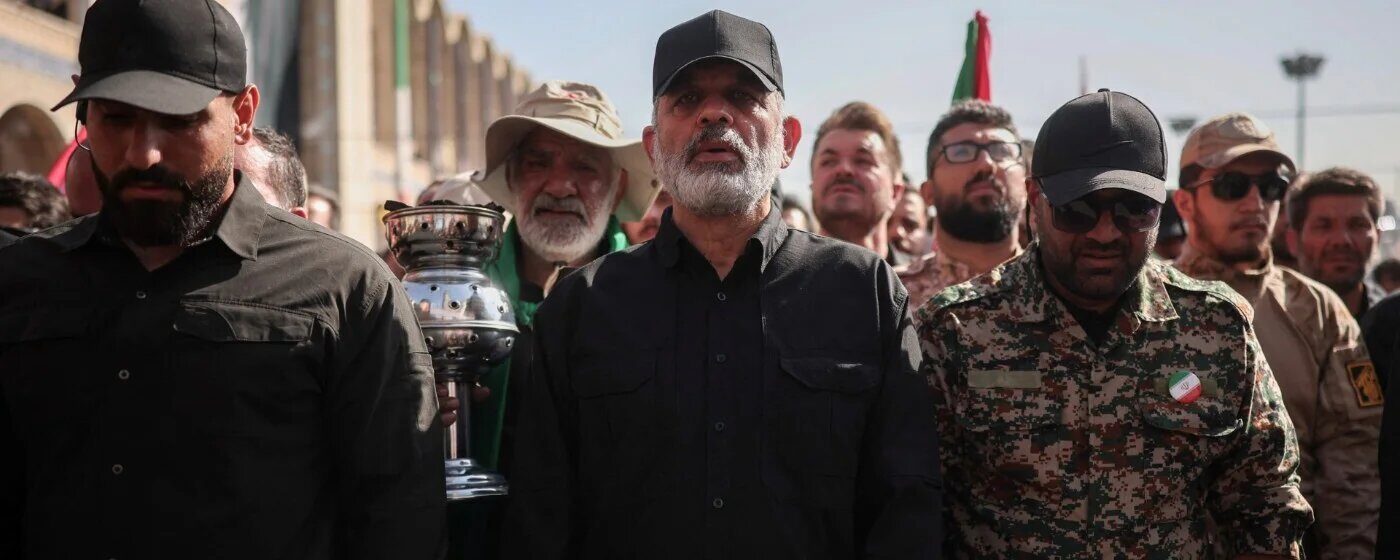
On 13 July 2026, the Home Secretary designated Iran’s Islamic Revolutionary Guard Corps under the new National Security (State Threats) Act — the terrorist-style listing that campaigners, parliamentarians and the Iranian diaspora have demanded for the better part of a decade. Alongside the IRGC, two other groups were designated: the “Islamic Movement of Companions of the Right” (IMCR), the front that claimed a wave of attacks on British Jews earlier this year, and Russia’s GRU Volunteer Corps.
Once Parliament approves the designations this week, supporting or assisting these groups will carry sentences of up to fourteen years. Acts of sabotage carried out on their behalf — arson included — can attract life imprisonment. Prosecutors will no longer need to prove a foreign-power connection in every case involving these groups, removing the evidential hurdle that has made state-proxy prosecutions so difficult.
This is the right decision. It is also years late, and the story of the delay matters as much as the designation itself — because it explains what the British state tolerated in the meantime, and because it frames the two questions everyone in this space is now asking. What happens to the regime’s institutional infrastructure in the UK, the network of Islamic centres that researchers and parliamentarians have documented for years? And what happens to the British influencers and commentators who accepted the regime’s hospitality and amplified its narratives, in some cases while it was at war?
What forced the government’s hand
The proximate cause is not in dispute, because the government has stated it plainly. The IMCR publicly claimed responsibility for seven attacks at UK locations linked to Jewish and Israeli communities and Persian-language media, including the antisemitic arson of four Hatzola ambulances in Golders Green on 23 March. The government’s own assessment is that members of the IRGC’s Qods Force sat behind the IMCR and “almost certainly” directed its attacks across Europe — worth noting the hedge, because that is the government’s chosen wording, and it reflects intelligence-grade rather than courtroom-grade certainty.
The broader backdrop is equally well documented. MI5 identified at least twenty potentially lethal Iranian-backed plots against people in the UK within a single year, overwhelmingly targeting Jewish communities, dissidents and journalists. The UK had already sanctioned the IRGC in its entirety, along with more than 550 linked individuals and entities. What it had refused to do, year after year, was the thing its closest allies had already done: name the organisation for what it is and criminalise support for it.
The anatomy of a delay
The United States designated the IRGC a foreign terrorist organisation in 2019. Canada followed in 2024, the EU earlier this year. Britain — the country whose own security service was logging twenty-plus regime plots on home soil — was among the last major Western allies to act. The delay had an official explanation and an unofficial one, and both deserve scrutiny.
The official explanation was legal. Jonathan Hall KC, the independent reviewer of terrorism legislation, advised that the Terrorism Act 2000 was not designed to proscribe an organ of a foreign state, and the IRGC — however autonomous its economic empire and however direct its answerability to the Supreme Leader rather than to any elected body — is formally part of the Iranian state. The government adopted this position and maintained that a bespoke legislative tool was needed first. That much is documented fact.
Whether it was a genuine barrier is another matter, because there is an awkward precedent. The Wagner Group, a state-adjacent Russian paramilitary with longstanding and well-documented links to Russian military intelligence, was proscribed under that same Terrorism Act in September 2023. If Wagner could be banned under existing law, critics asked with some force, the claimed impossibility of listing the IRGC looked less like a legal principle and more like a policy choice dressed up as one.
The unofficial explanation points at the Foreign Office. Reporting and criticism across the political spectrum described institutional FCDO resistance rooted in the belief that proscription would sever diplomatic and back channels with Tehran — channels valued for nuclear diplomacy, detained dual nationals and regional de-escalation. This should be graded carefully: FCDO reluctance is widely reported and was repeatedly raised in Parliament, but the government has never formally conceded that diplomacy was the reason for delay. What is on the record is the pattern. As late as March 2026, with the IMCR attacks unfolding, the Foreign Secretary was still deflecting demands in the Commons with the formula that proscription decisions were kept “under close review,” while rejecting calls to fast-track the new legislation.
The timeline, laid end to end, tells the story without editorialising. Hall’s recommendation for a proscription-style tool aimed at state proxies sat unimplemented for years. Parliamentary pressure was absorbed and deflected through successive sessions. Then an Iranian-directed front claimed seven attacks on British soil, several of them targeting the Jewish community in north London, and within months the legislation was fast-tracked, received Royal Assent, and the designation followed inside a week. The designation followed the attacks. It did not prevent them. That is the cost of the delay, and it should not be forgotten in the self-congratulation now underway.
The regime’s institutional network in Britain
The question of what designation means for the regime’s UK infrastructure is best answered by first establishing how extensively that infrastructure has been documented — not by anonymous accounts, but by Parliament, the charity regulator and the government’s own advisers.
The centrepiece is the Islamic Centre of England in Maida Vale, London, which the Foreign Affairs Select Committee has described as the “London office” of the Iranian regime and an arm of the Iranian state. Its director is personally appointed as the UK representative of Iran’s Supreme Leader — an appointment read out publicly at inauguration. The Charity Commission has had the centre under statutory inquiry, its most serious form of investigation, since November 2022, having earlier issued an official warning over a 2020 vigil held at the centre for Qassem Soleimani, the architect of Iran’s overseas terror operations. During the inquiry, the regulator directed the charity to remove a clause from its own constitution requiring at least one trustee to be the Supreme Leader’s official UK religious representative — a provision the Commission said demonstrated an apparent lack of independence. The centre was briefly closed in 2023 and has since been subject to further orders over online content promoting Khamenei and material calling for Israel’s destruction.
Nor is it an isolated case. Lord Walney, the government’s former independent adviser on extremism, reported that around thirty UK charities — many of them mosques and Islamic centres — are suspected of operating as soft-power instruments of the Iranian regime. Researchers have flagged affiliated or linked centres in Manchester, Birmingham, Newcastle, Glasgow and Watford; the leader of the Watford centre received an award from then-president Ebrahim Raisi and was later hosted in Iran by a senior IRGC commander, where state media reported she signed a memorandum promising to spread the ideals of the Islamic Revolution. A Manchester Labour MP has called in the Commons for a wider investigation into cultural centres in his city allegedly linked to the regime. The centres, for their part, have consistently denied the accusations, insisting their work is religious, educational and charitable in nature — a defence that must be recorded, and that is about to be tested in a far harsher legal environment.
So what does designation actually change for them? Precision matters here, because the answer is not “they will be shut down.” Designation creates no power to close a building or dissolve a charity. What it creates is criminal exposure for conduct. Supporting the IRGC for a prohibited purpose, assisting it, or receiving material benefit from it or its organs are now offences carrying up to fourteen years. Hosting IRGC commanders for lectures, coordinating activity with Qods-linked bodies, channelling funds through regime-connected structures — the very categories of conduct documented at several centres over the years — now carry direct criminal risk where the legal tests of knowledge, linkage and purpose can be met.
And designation does not operate alone. It converges with two other tracks that were already tightening. The Charity Commission’s inquiry into the Islamic Centre of England remains open, and the government has announced strengthened powers for the regulator to close charities that promote extremism. Separately, the Foreign Influence Registration Scheme requires anyone acting in the UK at the direction of the Iranian state to register their activities or risk prosecution. Lord Walney’s assessment was that IRGC proscription “looms large” over the whole question — that properly identifying the IRGC as a terrorist organisation makes dismantling the soft-power network far easier. That theory now gets its test. The things to watch are the outcome of the ICE inquiry, whether any trustee-level prosecutions follow, and whether “we are just a religious charity” continues to function as a shield.
The influencers
The third question is the one generating the most heat: what happens to British commentators who accepted the Iranian state’s hospitality and amplified its narratives?
The case study everyone reaches for is Bushra Shaikh, the former Apprentice contestant turned political commentator, and it is worth setting out precisely what is publicly documented — no more and no less. According to an investigation by Factnameh, an Iranian fact-checking organisation, Shaikh took part in two press tours in 2026 organised by IRIB World Service, the international arm of Iran’s state broadcaster, and played what the investigation described as a highly active role in reproducing the government’s narrative. She interviewed regime officials including the foreign ministry spokesman, and her content was amplified by Press TV and the Tehran Times. She spoke at a pro-regime rally in Tehran at which Hezbollah flags — the banner of a group proscribed in the UK since 2019 — were visible in the crowd. In May 2026 she was referred to the Metropolitan Police’s Counter-Terrorism Command over that speech, with reported allegations concerning the Terrorism Act offence of inviting support for a proscribed organisation, and questions raised separately about her obligations under the Foreign Influence Registration Scheme.
Her side must be stated with equal clarity. Shaikh denies receiving payment from any state actor, has dismissed the reporting as baseless accusations, and frames her work as independent journalism countering one-sided Western coverage of Iran. A police referral is not a charge; a charge is not a conviction; and nothing in the public record establishes that she has committed any offence.
What changed on 13 July is the legal landscape around this entire category of activity. Before designation, promoting IRGC narratives was not, in itself, an offence — however distasteful the spectacle of British commentators touring a country whose regime was simultaneously directing attacks on British streets. After designation, expressing support for the IRGC for a prohibited purpose, assisting it, or receiving material benefits from it or its organs can carry up to fourteen years. The new offences will not apply retroactively; past trips and past posts are beyond their reach. What they transform is the risk calculus for the next tour, the next facilitated trip, the next platform appearance — for everyone operating in this space.
Even setting the new Act aside, the exposure was already multiplying. Anything touching Hezbollah was already criminal territory under the Terrorism Act 2000. The Home Office’s response to the Shaikh trips was unambiguous on the registration scheme: anyone acting in the UK at the direction of the Iranian state faces a choice between registering their activities and risking prosecution. Sanctions enforcement runs on a separate track again. Investigators now have multiple overlapping regimes, and they only need one to stick.
Realism is warranted about outcomes. Prosecution under the new offences requires specific elements — knowledge, a demonstrable link to a designated body, a prohibited purpose prejudicial to UK interests — and the Act contains statutory defences for genuine journalism, added in the Lords precisely to protect legitimate reporting. Most cases will end in assessment rather than charges, and that is how it should be in a country that takes both security and free expression seriously. But the era of consequence-free, state-facilitated amplification tours is very likely over. High-profile, high-volume cases with documented state organisation are exactly what these powers were designed to reach.
The test that starts now
The designation of the IRGC is overdue, reactive and welcome, in that order. It took seven claimed attacks on British Jews and Persian-language media, more than twenty plots, the sustained work of researchers and journalists documenting the regime’s UK network, and years of parliamentary pressure to overcome Whitehall’s institutional caution. The legal architecture the government said it needed now exists.
Which means the excuses have run out. The real test is enforcement: whether the British state actually deploys these powers against the network it has spent a decade documenting — the centres, the fronts, the financiers, the amplifiers — or whether the National Security (State Threats) Act 2026 becomes another statute that gathers dust while the regime adapts around it. The evidence base is already assembled, much of it by the government’s own committees and regulators. What has been missing is will. We are about to find out whether that has changed.
This article is based on the government’s designation announcement of 13 July 2026, parliamentary records, Charity Commission statements, the Walney report, and published investigations including Factnameh’s findings on Iranian state press tours. Where claims rest on reporting or attribution rather than official record, the text says so. Nothing here asserts the guilt of any named individual; referrals and investigations are described as exactly that.