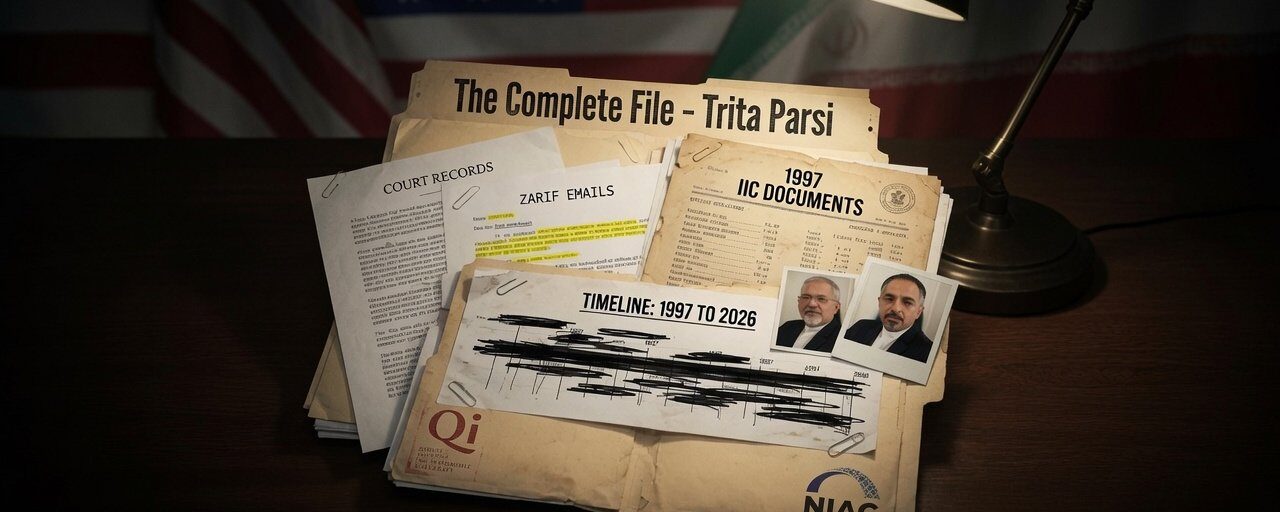
Thirty years of documents, in order – from “Towards the creation of an Iranian-American lobby” to the deportation story that wasn’t
Trita Parsi may be the most influential Iranian-born voice in Washington. From a 1990s one-man lobbying outfit, to the National Iranian American Council, to the Quincy Institute – where, during the 2026 war, he became perhaps the most-quoted critic of the conflict in America – his career spans every chapter of the Iran debate in US politics.
He has also spent most of those thirty years trailed by one accusation: that he is, in effect, Tehran’s advocate in Washington. He has never been charged with anything. He denies the accusation completely. And yet the paper trail behind it is unusually deep – because in 2008, Parsi’s own organization filed a lawsuit that forced its internal files open in federal court.
This article assembles that record in full: his own memos, his own emails, a federal judge’s findings, the testimony of the man who brought him to Washington, the leaked-email investigations that touched his brother, and the June 2026 deportation story that collapsed within hours. Every claim below is graded – what’s documented, what’s alleged, what’s disputed. Read it and judge for yourself.
The beginning: Ahvaz, Sweden, Washington
Trita Parsi was born in Ahvaz, Iran, to a Zoroastrian family – members of Iran’s ancient pre-Islamic religious minority. In the turmoil surrounding the 1979 revolution, his family fled, and he was raised in Sweden. He later moved to the United States, earned a PhD at Johns Hopkins under Francis Fukuyama’s school of international studies, and went on to write award-winning books on US-Iran-Israel relations, including Treacherous Alliance. He has lived in the US for more than 25 years as a green-card holder, reportedly retaining Iranian and Swedish citizenship.
None of that is in dispute. He is a genuine scholar with a genuine biography of exile. What follows is the rest of the record.
The community verdict – and why it runs so deep
Before the documents, understand who has been making this accusation the longest. It is not Washington neoconservatives. It is Iranian-Americans – exiles, dissidents, human-rights activists, and families who buried loved ones the Islamic Republic killed.
For large parts of the diaspora, Parsi and NIAC represent something specific: an organization that claims to speak for Iranian-Americans while consistently advocating the policies Tehran wants – sanctions relief, engagement, an end to pressure – and treating the community’s demand for regime accountability as warmongering. In July 2019, Iranian-Americans protested outside NIAC’s own DC office, denouncing it as the representative of “the corrupt and brutal Islamic Republic regime.” Activists including Masih Alinejad – herself the target of regime kidnapping and assassination plots on US soil – have publicly clashed with NIAC for years. Lawdan Bazargan, whose brother was executed in the 1988 prison massacres and who organizes against regime apologism in the West, has campaigned relentlessly against the organization. Atena Daemi, writing from inside an Iranian prison, accused NIAC of whitewashing the regime’s crimes. And through the Green Movement in 2009, Woman-Life-Freedom in 2022, and the 2026 uprising, critics have pointed to the same pattern: responses quick to warn against US or Israeli escalation, slower and quieter on the executions, torture, and shootings themselves.
This is not abstract policy disagreement. For this community, the question of who speaks for them in Washington is inseparable from who killed their families in Tehran. That is the weight the accusation carries – and it is why the paper trail below, which falls short of criminal proof, fuels suspicion rather than settling it.
His defence – and the rebuttal
Fairness requires stating Parsi’s answer, because he has one, and it has kept him in business for thirty years.
His case: NIAC and Quincy represent Iranian-Americans, not Iran – a community that overwhelmingly opposes war on its homeland. Diplomacy and de-escalation protect ordinary Iranians from bombs and sanctions-driven poverty; “maximum pressure” strengthens hardliners and hurts the people. He points to his family’s flight from the revolution, his Zoroastrian minority background, his scholarly record, and instances where he has criticized the regime – its human-rights abuses, the Holocaust-denial conference under Ahmadinejad. He opposes regime change imposed from outside, he says, not change itself. And he characterizes his fiercest critics as neoconservatives, monarchists, and warmongers whose policies would burn Iran to save it.
The rebuttal, from the record: Every element of that defence coexists with the documents. The stated mission of his own first organization was safeguarding Iran’s interests – his website’s words, not his critics’. The community-voice framing coexists with a memo proposing an AIPAC-style lobby with himself as director, with court-exposed coordination with Iran’s UN ambassador, and with internal admissions of lobbying by an organization publicly denying it was a lobby. His occasional criticisms of Tehran are real – and critics note they are precisely what a sustainable advocacy position requires; Judge Bates, having read the private correspondence behind the public posture, still described the conduct as consistent with regime advocacy first. The policy output, across every era – JCPOA, maximum pressure, the 2026 war – reliably lands on Tehran’s preferred side of the ledger, with sanctions relief never conditioned on verifiable human-rights improvement. And the regime’s own television pundits claim NIAC as their lobby, a compliment no amount of careful positioning has managed to refuse.
None of that converts a pattern into proven agency – the next sections are precise about that line. But it explains why the defence persuades Washington audiences and almost no one in the diaspora: the diaspora has watched the pattern for thirty years.
1997: The lobby that called itself a lobby
In 1997, Parsi founded Iranians for International Cooperation (IIC). There is no mystery about what it was, because IIC said so itself. Its own public FAQ – archived on the Wayback Machine in versions spanning 1999 to 2005 – posed the question of whether IIC was a lobby and answered yes. Its stated mission: “to safeguard Iran’s and Iranian’s interests,” with the lifting of US sanctions on Iran listed as its first priority.
That phrasing deserves a pause. Not Iranian-Americans’ interests. Iran’s interests. In the organization’s own words, on its own website, for six years.
The door into Washington: Bob Ney
Parsi’s entry point to Capitol Hill was Congressman Bob Ney, Republican of Ohio – a Farsi-speaking former resident of Iran whom Parsi had met as an exchange student and in whose office he later interned. From Ney’s office, Parsi built the congressional network that would carry him for the next two decades. (Ney’s own career ended in prison, convicted in the Jack Abramoff corruption scandal – a footnote, not an accusation against Parsi, but part of the record.)
2002: The memo that should be famous
In 2002, working from a congressional email account, Parsi sent a memo that was later obtained and reported by Josh Rogin at Foreign Policy. Its title: “Towards the creation of an Iranian-American lobby.”
The memo laid out a plan for a lobbying operation in “strategic partnership” with NIAC, modeled explicitly on AIPAC – the American Israel Public Affairs Committee, the most powerful ethnic lobby in Washington. And it named a proposed executive director for the venture: Trita Parsi.
His words. His plan. His name. Whatever one concludes about everything that came after, the founding document exists and he wrote it.
NIAC – and the Zarif channel begins
That same year, Parsi co-founded the National Iranian American Council, publicly framed as a grassroots community voice for Iranian-Americans – explicitly not, in its public messaging, a lobby. He served as its president until 2018.
In December 2002, within months of NIAC’s founding, Parsi emailed lobbyist Roy Coffee the full contact details of Javad Zarif – then Iran’s ambassador to the United Nations, later its foreign minister and the face of the nuclear deal. The Parsi–Zarif channel that would surface in federal court a decade later starts here, in NIAC’s first year.
The business orbit: Atieh and the Namazi connection
Parsi’s longtime collaborator Siamak Namazi ran Atieh Bahar Consulting, the Tehran-based firm that specialized in walking foreign companies into Iran’s market. Documents later produced in court include an Atieh newsletter describing the firm’s “affiliate analyst in Washington, DC,” and an email from Atieh’s Bijan Khajehpour asking Parsi for his bank details to transfer funds.
Grade this precisely: documented financial and professional links to a Tehran-based consultancy whose business model depended on sanctions easing – the exact policy NIAC pursued. That is a documented alignment of interest. It is not, by itself, proof of direction.
2008–2015: The lawsuit that opened the files
Here is where the story becomes unique. In 2008, NIAC sued an Iranian-American writer, Hassan Daioleslam, for defamation – he had called NIAC a lobby for the Islamic Republic. Suing him meant discovery. Discovery meant NIAC’s internal emails, calendars and files entered the federal court record.
What discovery exposed:
The Zarif emails. Correspondence showing Parsi communicating with Iran’s UN ambassador and helping arrange Zarif’s meetings with members of Congress – first reported in detail by Eli Lake in the Washington Times in 2009.
The judge’s words. The case was ultimately dismissed on First Amendment grounds – as a public figure, NIAC had to prove “actual malice,” and could not. The court stressed it was not ruling Daioleslam’s claims true. But Judge John Bates, having read the emails, wrote that Parsi’s conduct was “not inconsistent with the idea that he was first and foremost an advocate for the regime.” Be precise about what that is: not a conviction, not a finding of agency – but a federal judge, reviewing the primary documents, declining to describe Parsi as independent.
The sanctions. The court record got worse from there. The DC Circuit found NIAC had “flouted multiple court orders” during discovery. Seventy-eight calendar entries were altered shortly before production – two-thirds of them in Parsi’s own calendar. Staff changed file labels from “lobbying” to “legislative direct.” NIAC was sanctioned $183,480, payable to the man it had sued.
The counterintelligence view. Former FBI counterintelligence officials who reviewed the emails for Lake’s reporting were blunt. Kenneth Piernick: “I would have cause to look into this further.” Oliver “Buck” Revell said arranging Zarif’s meetings on the Hill “would… require that person to register as an agent of a foreign power.”
An organization that sues to clear its name, hides and alters evidence in the process, pays six figures in sanctions and walks away with a judicial sentence like Bates’s – that is not a vindication. It is also not a conviction. It is exactly what it is, and it’s all on PACER.
The origin story, from the inside
Hooshang Amirahmadi – the Rutgers professor who first brought Parsi to Washington – later told Tablet magazine that he personally introduced Parsi to Zarif and said of NIAC: “Zarif wanted this organization and he developed it.”
That is one insider’s characterization, from a man with his own complicated history in US-Iran diplomacy. Weigh it accordingly. But it comes from Parsi’s own mentor, not his enemies.
Internal emails from the court record added another data point: NIAC’s own acting policy director acknowledged staff were spending more than 20 percent of their time on lobbying – significant for a 501(c)(3) that publicly insisted it wasn’t a lobby. That admission was cited in the 2020 letter from Senators Tom Cotton, Ted Cruz and Mike Braun asking the Justice Department to investigate NIAC for potential Foreign Agents Registration Act violations. No investigation was ever announced.
The pattern of positions
Across two decades, the through-line of NIAC’s advocacy is consistent: oppose sanctions, revive engagement, resist pressure on Tehran. NIAC opposed US funding for democratic opposition groups in Iran in 2007. After the US killed IRGC Quds Force commander Qassem Soleimani in 2020, NIAC joined coalition protests against “war on Iran.” The Hill credited NIAC’s work as one of the top lobbying victories of 2015, for the nuclear deal.
And the strangest endorsement comes from Tehran itself. On the Iranian television program Dialog, regime-aligned academics Foad Izadi and Bijan Abdolkarimi described NIAC as “the Islamic Republic’s lobby” – while complaining it was less effective than the Israeli and Arab lobbies. Their characterization, not proof of anything. But note who is doing the claiming.
2019: Quincy – the message gets a better address
In 2019, Parsi moved up. He co-founded the Quincy Institute for Responsible Statecraft, the Washington think tank seeded – unusually – by both George Soros’s Open Society and the Charles Koch Foundation, united by a shared belief that US military intervention abroad tends to backfire.
Be fair to Quincy, because fairness is what makes the rest of this credible. Quincy is a real anti-interventionist project with a genuine left-right base. It is not an Iran shop. Most of its scholars oppose war with Iran the same way they opposed the Iraq war. It discloses donors above $5,000 and says it refuses foreign-government money – more transparency than some of its critics offer. The claim “Quincy is an Iran front” overclaims and the funding record cuts against it.
The fair scrutiny is narrower and sharper: one specific person’s record inside it. Parsi arrived at Quincy as executive vice president and its driving force on Iran, carrying the entire documented file above. Under his lead, Quincy’s Iran output has been consistent: revive the deal, ease “maximum pressure,” treat regime change as counterproductive, build a regional order that includes Tehran. Whatever the motive, the output reliably matches the regime’s preferred outcome – now delivered with elite think-tank legitimacy instead of a lobby’s letterhead. Same messenger, bigger platform.
Critics at Hoover, EMET and Tablet argue Quincy institutionalizes the NIAC message at a higher level. Quincy answers that ending endless wars is simply good for America. Both positions belong on the record.
The brother: Rouzbeh Parsi and the Iran Experts Initiative
In 2023, leaked Iranian Foreign Ministry emails – investigated by Semafor and Iran International – exposed the Iran Experts Initiative: a network Tehran’s Foreign Ministry built to cultivate Western-based analysts. Among its principal creators: Rouzbeh Parsi, Trita’s brother, then a program head at the Swedish Institute of International Affairs.
Precision matters here more than anywhere. Per the Free Press’s reporting, Trita Parsi’s name did not appear in the ministry emails as an IEI member. His brother’s role is documented; his own membership is not. A subsequent internal investigation by the Swedish Institute found no evidence Rouzbeh was paid or controlled by Iran – but concluded he had been a principal creator of the initiative and had failed to disclose its work to the institute, Sweden’s foreign ministry, or Lund University. The institute ended his employment in May 2025. Rouzbeh denies cooperating with Tehran.
The brothers’ parallel roles in the engagement ecosystem are documented fact. Anything beyond that is inference. Say exactly that and no more.
2026: The war, the platform, the pushback
When the US-Israel war with Iran began in February 2026, Parsi became arguably the most-quoted American critic of the conflict – a rare voice cited everywhere from Democracy Now! and The Nation on the left to Steve Bannon’s War Room on the MAGA right, plus CNN and Al Jazeera in between. His reach into the America First audience was new and, by his own later account, exactly what made him a target.
The pushback was already building. In February 2026, the German Institute for Global and Area Studies cancelled a Berlin event featuring Parsi after backlash from Iranian activists and regime opponents; the institute cited security concerns. In the US, pro-Israel influencers – Laura Loomer most loudly – spent the spring publicly demanding his deportation, with Loomer declaring in May that his “days in our country are numbered.”
June 2026: The deportation story – all of it
On June 11, 2026, the Free Press published an exclusive by Jay Solomon: the State Department, it reported, had launched an investigation of Parsi and could seek to revoke his green card and deport him, citing US officials and documents. The legal theory under discussion was INA Section 212(a)(3)(C) – the Cold War-era provision allowing removal of a non-citizen whose presence carries “serious adverse foreign policy consequences.” An internal Quincy memo from April, reviewed by the outlet, showed the institute had already retained an immigration lawyer, prepared a habeas corpus petition in case Parsi was suddenly detained and secured its chairman’s commitment to fund the legal fight.
Then, within hours, the record shifted – and honesty requires reporting all of it. A State Department official told reporters the department “has no plans to revoke the green card of Mr. Parsi at this time,” and never confirmed that an investigation existed. The same statement carried a warning: no foreign national is guaranteed a right to be in the country and the department would “unapologetically terminate” the status of anyone undermining national security.
Parsi’s own account, published on his Substack: he doesn’t believe there was an investigation at all. He believes elements within the State Department wanted one and that the story was designed to trigger it through external pressure – a “hit piece” meant to manufacture the very outcome it reported. He noted Quincy heard from administration sources that no principals were aware of any probe and that the story’s source may have been a “rogue actor.” Days later he was back on air, discussing the ceasefire negotiations.
Both facts stand. The report existed and cited real documents. The department publicly refuted it. As of this writing, no formal action against Parsi has been announced and his position is formally unchanged – and materially uncertain.
The part you might not expect
Here is where I’ll say something some readers won’t like. The deportation push was wrong – and the people who know Parsi’s record best said so first.
Kaveh Shahrooz – a human-rights lawyer and one of NIAC’s fiercest critics, a man who has spent a decade prosecuting the case against Parsi in public – opposed it flatly: “Unless the government can demonstrate that Parsi violated US law… deporting him would amount to targeting someone for their speech and political beliefs. An abuse of government power directed at someone you despise today can very easily be directed at you, or at someone you support, tomorrow.”
He’s right. And we already have the proof: in April 2026, the same administration revoked the green cards of two Iranian women falsely identified as relatives of Qassem Soleimani – apparently on the strength of an influencer’s claim. That weapon does not check ideology before it fires. It lands on dissidents, students and exiles at least as easily as it lands on the people we’d like it to. Those of us who fled a regime that deports, imprisons and kills people for speech do not get to borrow its tools.
The case against Trita Parsi was never going to be settled by an immigration officer. It is settled – to whatever degree it can be – by the documents.
The honest summary
So here is what thirty years of paper actually shows.
A man who, in writing, under his own name, proposed himself as executive director of an Iranian-American lobby modeled on AIPAC. Who ran an earlier outfit whose own FAQ said its mission was to safeguard Iran’s interests. Who opened a channel to Iran’s UN ambassador in his organization’s first year and helped arrange that ambassador’s meetings in Congress. Whose organization sued a critic, hid and altered evidence, was sanctioned $183,480 and lost. Whose conduct a federal judge described as “not inconsistent with” being “first and foremost an advocate for the regime.” Whose mentor says the regime’s own foreign minister “wanted this organization.” Whom Tehran’s television pundits call their own lobby. Whose brother helped build the regime’s analyst-cultivation network – while his own name, it must be said, appeared nowhere in those emails.
And who, across all of it, has never been charged with a single crime – a fact I state not as a courtesy but because stating it is what makes everything else here credible.
Read the documents. All of them. Then draw your own conclusions.
The file – primary sources
- “Towards the creation of an Iranian-American lobby” memo – Josh Rogin, Foreign Policy
- IIC FAQ –
captures, 1999–2005
- Parsi v. Daioleslam – US District Court, DC (Judge Bates, 2012); DC Circuit (2015)
- Eli Lake, Washington Times (2009) – the Zarif emails and ex-FBI counterintelligence quotes
- Tablet – Hooshang Amirahmadi interview; Quincy founding profile
- Cotton / Cruz / Braun letter to DOJ (2020) – FARA referral citing internal lobbying-time admission
- Semafor + Iran International (2023) – Iran Experts Initiative leaked emails; Rouzbeh Parsi
- Swedish Institute of International Affairs internal investigation (2025) – Rouzbeh Parsi findings and dismissal
- Quincy Institute – IRS filings and public donor disclosures (
)
- The Free Press (June 11, 2026) – Jay Solomon report; April Quincy legal-preparation memo
- State Department statement (June 12, 2026) – via Anadolu Agency and others
- Trita Parsi, Substack (June 13, 2026) – “So they tried to deport me…”
- Kaveh Shahrooz – public statements opposing the deportation push
- Diaspora record – July 2019 protest outside NIAC’s DC office; Atena Daemi’s statement from prison; public campaigns by Masih Alinejad, Lawdan Bazargan and other activists (verify each activist’s specific wording against their own posts before quoting directly)
Primary sources over spin. Draw your own conclusions.