
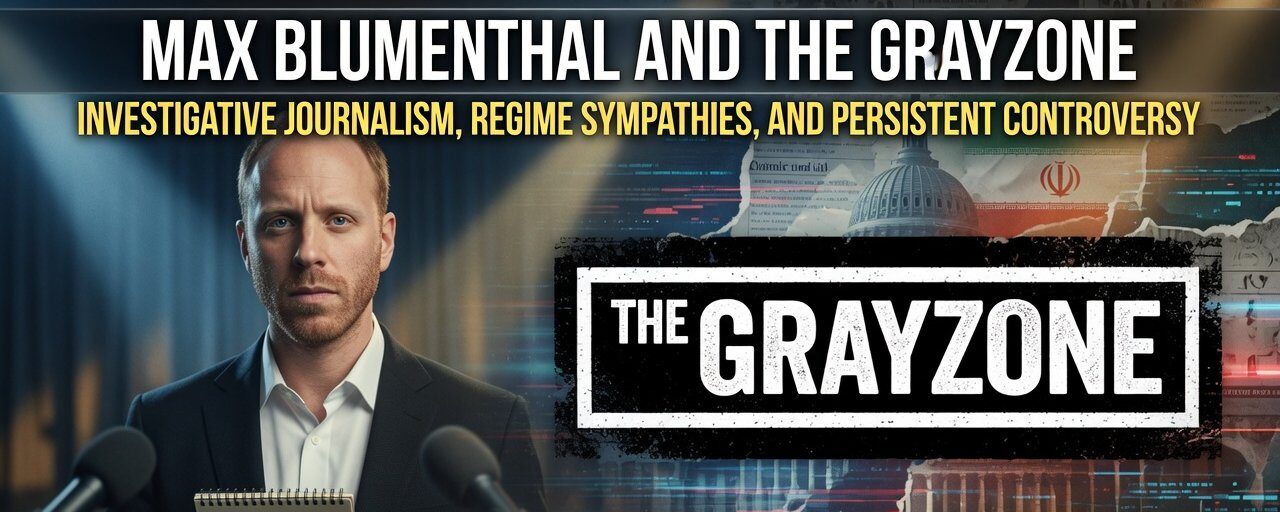
Max Blumenthal is an American journalist, author, blogger and filmmaker best known as the founder and editor of The Grayzone, an independent news website launched in 2015. Once a contributor to mainstream outlets like The Nation, The Daily Beast and Al Jazeera English, Blumenthal has shifted toward sharply critical coverage of U.S. foreign policy, Israel and Western interventions. His work and the site frequently challenge official narratives on conflicts involving Russia, Syria, China, Venezuela and Iran, often drawing accusations of disinformation, selective reporting and alignment with authoritarian regimes.
Early Career and Evolution
Born in 1977 in Boston to a prominent Jewish family – his father, Sidney Blumenthal, advised Presidents Bill and Hillary Clinton – Blumenthal graduated from the University of Pennsylvania with a history degree. His early books, including the bestseller Republican Gomorrah (2009), critiqued the American religious right. He gained prominence for reporting on the Israeli-Palestinian conflict, producing documentaries like Killing Gaza and books such as Goliath (2013), which harshly criticised Israeli policies.
Blumenthal left Al Akhbar in 2012 over its Syria coverage, initially criticising Assad as a tyrant. By the mid-2010s, however, his positions hardened against Western-backed regime-change efforts in Syria and elsewhere. He founded The Grayzone (initially affiliated with AlterNet) as a platform for “anti-imperialist” journalism. The site features in-depth reporting, often from on-the-ground perspectives in adversarial nations and has grown a large online following through X, YouTube and podcasts.
Editorial Focus and Style
The Grayzone specializes in:
- Exposing what it calls U.S. “hybrid warfare,” sanctions and propaganda.
- Skepticism toward Western atrocity claims (e.g., Syrian chemical attacks, Uyghur genocide scale).
- Coverage of the “Axis of Resistance” (Iran and allies) that contextualises their actions as defensive against imperialism.
The outlet’s style is polemical yet heavily footnoted, blending original leaks/documents with analysis. It has broken stories on topics like UK influence operations and Israeli lobbying but is frequently accused of cherry-picking and whataboutism.
Key Controversies: Iran and the Axis of Resistance
A major focus of criticism involves Blumenthal’s and The Grayzone’s coverage of Iran. Blumenthal has traveled to Tehran, interviewed officials and reported favorably on the country’s resilience under sanctions while questioning opposition narratives and protest casualty figures. He has described events like mourning for Supreme Leader Ali Khamenei as massive anti-imperialist mobilizations.
Wyatt Reed and Press TV: Managing editor Wyatt Reed received thousands of dollars for freelance contributions to Iranian state broadcaster Press TV in 2020–2021 (while also at Sputnik). Hacked documents revealed the payments; Reed and Blumenthal note this was public, pre-Grayzone work. The Washington Post highlighted it as an example of overlapping state-media ties complicating disinformation attribution. Reed’s role at Grayzone began later.
Mohammad Marandi and Narrative Amplification: Grayzone has platformed or aligned with figures like Press TV regular Mohammad Marandi. Critics, including Iranian opposition analysts, link this to Tehran’s strategy of cultivating Western voices to launder narratives – e.g., framing protests as foreign plots or labeling victims as spies. Threads documenting influencer ops at regime events often cite Grayzone-aligned patterns.
The site’s broader Axis coverage – defending Hezbollah, questioning October 7 details and criticising Israel – reinforces perceptions of consistent alignment with Iranian interests.
Funding and Operations
Grayzone claims full independence through reader support (Patreon, fundraisers). A 2023 GoFundMe raising ~$90,000+ was frozen by the platform over vague “external concerns” (widely tied to Ukraine reporting), though funds were eventually released. Blumenthal has disclosed property purchases linked to earnings and denied any government funding.
Staff histories include prior work at RT, Sputnik and (for Reed) Press TV, which critics cite as influence vectors even absent direct site funding.
Other Major Criticisms
- Syria, China, Venezuela: Accused of denialism on chemical attacks, Uyghur abuses and authoritarian excesses.
- October 7/Gaza: Early questioning of atrocity reports and promotion of Israeli “friendly fire” theories.
- Internal Feuds: Public split with Ben Norton highlighted control and direction disputes.
- FARA and Influence: Reed’s past payments raised theoretical compliance questions, though no charges resulted. FARA enforcement against journalists remains rare.
Impact and Reception
The Grayzone wields significant online influence among anti-war audiences but is Wikipedia-deprecated for reliability and labeled fringe by many outlets. It thrives amid declining trust in legacy media, providing counter-narratives that resonate in a polarised information environment. Supporters praise its rigor and courage; detractors see it as a sophisticated amplifier for authoritarian propaganda.
Blumenthal remains a polarising figure: a Jewish critic of Israel accused of antisemitism by some and a relentless investigator by others. His work on Iran exemplifies the site’s approach – challenging sanctions and interventions while drawing scrutiny for proximity to regime perspectives.
In an era of hybrid information warfare, The Grayzone illustrates the blurred lines between independent journalism, ideological commitment and narrative alignment. Whether it serves as vital dissent or unwitting (or witting) enabler of regimes like Iran’s continues to divide observers. Readers are encouraged to cross-reference primary sources and evaluate claims on evidence.