
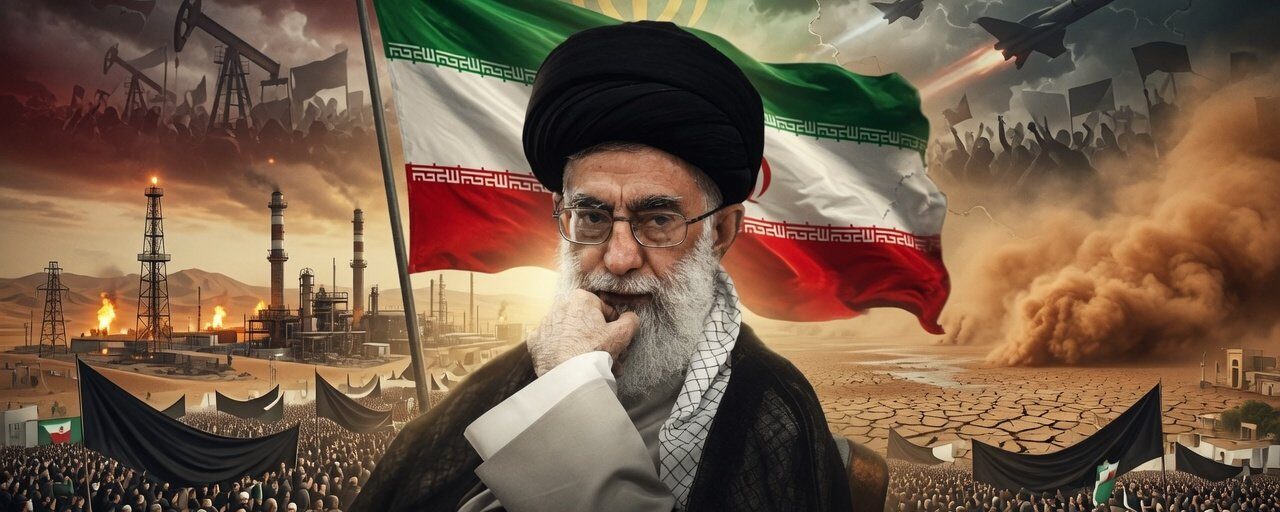
Ali Khamenei’s Reign of Terror (1989–2026)
While millions of Iranians struggled to afford bread, the regime reportedly spent lavishly on the funeral of Ali Khamenei — a man who personally controlled Setad, a business empire built partly on assets seized from ordinary Iranians and valued by Reuters at around $95 billion. More than the annual oil revenue of the country he impoverished.
Here is the full record of his 37 years as Supreme Leader — and the crimes that built the system he led.
The Foundation: 1988
Before becoming Supreme Leader, Khamenei was president during the 1988 massacre of political prisoners — estimates range from 1,000 to as many as 30,000 executed in a matter of months. He defended the killings publicly and later elevated their perpetrators to the highest offices, including Ebrahim Raisi, a member of the “death committee” he made president. The Islamic Republic under Khamenei was never asked to answer for its founding crime — he made sure of it.
1990s: Assassinations at Home and Abroad
• Chain Murders (1988–1998): Dozens of dissident writers, intellectuals and political activists were assassinated inside Iran by agents linked to the Ministry of Intelligence.
• The killing machine went global: Abdolrahman Ghassemlou (Vienna, 1989), Kazem Rajavi (Geneva, 1990), former PM Shapour Bakhtiar (Paris, 1991), entertainer Fereydoun Farrokhzad (Bonn, 1992), and the Mykonos restaurant assassinations (Berlin, 1992) — where a German court formally found the orders came from Iran’s top leadership, including Khamenei himself.
• Buenos Aires: the 1992 Israeli embassy bombing (29 killed) and the 1994 AMIA Jewish community centre bombing (85 killed) — Argentine prosecutors indicted senior Iranian officials for both.
• 1999 Tehran University raid: security forces stormed student dormitories during the largest student uprising since the revolution — beatings, mass arrests, students thrown from windows, at least one confirmed killed.
2000s: Crushing Dissent
• Zahra Kazemi (2003): the Canadian-Iranian photojournalist was arrested for taking photos outside Evin prison and tortured to death in custody.
• 2009 Green Movement: dozens killed, thousands arrested after the stolen election. Detainees were tortured and raped at the Kahrizak detention centre — a scandal so grotesque even regime insiders admitted it.
2010s: Shooting Into Crowds
• Dey protests (2017–18): around 25 killed, roughly 5,000 arrested as economic protests spread to dozens of cities.
• Bloody November (2019): security forces opened fire on nationwide protests under a total internet blackout. Amnesty documented 304+ deaths; Reuters, citing officials, reported around 1,500 killed in under two weeks.
• Flight PS752 (2020): the IRGC shot down a Ukrainian passenger plane, killing all 176 people on board — then lied about it for three days.
2020–2025: The War on Women, and a Record in Blood
• Judicial murder as policy: wrestler Navid Afkari executed in 2020 on tortured confessions. Journalist Ruhollah Zam lured from France, abducted, and hanged in 2020. German-Iranian Jamshid Sharmahd kidnapped in Dubai in 2020 and executed in 2024.
• Hostage diplomacy: dozens of dual nationals — Nazanin Zaghari-Ratcliffe, Ahmadreza Djalali and many others — held for years as bargaining chips.
• Mahsa Amini uprising (2022): at least 551 killed per HRANA, including dozens of children. Thousands blinded or maimed by shotgun pellets deliberately fired at faces. On “Bloody Friday” in Zahedan alone, security forces killed at least 66 people in a single day, with local groups counting close to 100.
• Protest executions: Mohsen Shekari, Majidreza Rahnavard and others hanged after sham trials measured in minutes.
• Schoolgirl poisonings (2022–23): thousands of students affected in unexplained poisoning waves that spread terror through girls’ schools — no one ever held accountable.
• Systematic persecution of Baha’is, Kurds, Baluchis, Ahwazi Arabs and other minorities throughout — Kurdish and Baluchi prisoners have long made up a disproportionate share of executions.
• By 2025, Iran was executing at record pace — rights groups counted over 1,000 executions that year alone, the highest in decades and the world’s highest per capita.
The War on Truth
• Throughout his rule, Iran ranked among the world’s top jailers of journalists — and according to the Committee to Protect Journalists, it holds the highest number of documented cases of torture and beatings of imprisoned media workers since records began in 1992.
• Niloofar Hamedi and Elaheh Mohammadi, the two journalists who broke the story of Mahsa Amini’s death, were imprisoned for the crime of reporting it.
• Censorship was permanent state policy: tens of thousands of websites filtered, social media platforms banned (while officials used them freely), satellite broadcasts jammed, and VPN use criminalised — forcing 80+ million people to break the law daily just to read the news.
• The repression followed journalists abroad: exiled Iranian reporters in London and elsewhere faced regime-linked death threats and attacks, including the 2024 stabbing of an Iran International presenter outside his home.
• And when the truth became too big to censor, he simply switched the country off: total internet blackouts in 2019 and 2026 — each one a prelude to mass killing.
The “Shia Crescent”: An Empire Built on Iranian Poverty
For three decades, Khamenei poured Iran’s wealth into a regional project Iranians never voted for:
• Tens of billions of dollars to save Bashar al-Assad’s regime in Syria, including recruiting impoverished Afghan refugees — among them, reportedly, child soldiers — into the Fatemiyoun Brigade to die in a foreign war.
• An estimated $700 million a year to Hezbollah, plus funding and arms for Hamas, the Houthis, and Iraqi militias.
• Shahed drones supplied to Russia to kill civilians in Ukraine — earning Iran yet another layer of sanctions and isolation.
The cost to Iranians: hundreds of billions in lost oil revenue and investment under sanctions, a collapsed rial, and pariah status. “Death to America” was never a foreign policy — it was a spending programme, paid for by Iranian workers and pensioners.
And here is the verdict of history: the empire collapsed before he did. Assad fell in December 2024. Hezbollah was decapitated. Hamas was decimated. The proxies he built to keep war away from Iran’s borders instead brought it to his own bunker. Every dollar, wasted. Every life, wasted.
A Plundered Land
The repression extended to the land itself. Iran’s natural wealth was strip-mined to keep the system alive:
• A manufactured water crisis: over-extraction for a doomed “self-sufficiency” drive, wasteful IRGC-linked dam projects, and depleted aquifers. Lake Urmia — once the Middle East’s largest lake — largely dried up. Wetlands vanished, dust storms multiplied, and the ground beneath Tehran and Isfahan is literally sinking.
• Air so toxic it kills: burning mazut and outdated fuel put Iranian cities among the most polluted on Earth, with schools regularly closed for smog.
• Forests reduced to under 7% of the country’s land, with deforestation and desertification accelerating year after year.
• Environmental activists treated as enemies of the state: conservationists jailed on espionage charges; one, Kavous Seyed-Emami, died in custody in 2018.
A regime that shoots its people does not spare its rivers. Khamenei leaves the next generation a poisoned, thirsty, sinking country.
December 2025 – January 2026: The Massacres
What began as protests over bread prices became a nationwide uprising across more than 200 cities — and Khamenei answered with the bloodiest crackdown in the Islamic Republic’s history, reportedly ordering security forces to crush the protests “by any means necessary.”
• The death toll: Khamenei himself admitted on state TV that “several thousand” were killed. The regime’s official count is 3,117. But leaked internal documents — including an IRGC intelligence report to the Supreme National Security Council — along with hospital records and doctors’ networks, indicate the true toll runs into the tens of thousands, concentrated in just two nights, 8–9 January. By the regime’s own hand, by the regime’s own numbers.
• Foreign killers: thousands of fighters from Iraqi militias were reportedly bused across the border and paid to shoot Iranian protesters when the regime feared its own forces might refuse.
• Hospitals became hunting grounds: security forces raided hospitals, dragged wounded protesters from their beds, and in documented cases shot injured patients where they lay.
• Mass arrests: over 42,000 documented arrests, with forced confessions broadcast on state TV and detainees held in secret facilities.
• “Bullet fees”: families were forced to pay to recover the bodies of their murdered children, threatened over funerals, and pressured into silent burials — while the regime concealed deaths in mass graves.
• Two near-total internet blackouts — through January, and again from 28 February to late May — to hide the killing from the world.
• The executions continue: hundreds of politically motivated executions in recent months, with many more protesters on death row after trials lasting minutes.
The Reckoning Begins
The EU and Ukraine designated the IRGC a terrorist organisation over the massacres. The US sanctioned Ali Larijani and the other architects of the January killings — carried out, by their own documents, on Khamenei’s orders. President Pezeshkian publicly apologised to the nation for the massacres. The regime admitted its guilt while denying its scale.
The System Outlived Him
Khamenei was killed on 28 February 2026 — but the machine he built kept running without him. The blackout continued for months. The executions accelerated. And when his son Mojtaba was installed as Supreme Leader — a hereditary succession in a “republic” — Iranians answered from their windows: “Death to Mojtaba.”
This week the regime buries him with millions of dollars it stole from a starving nation. For nearly four decades, Ali Khamenei presided over political repression, censorship, mass arrests, torture, executions, assassinations on four continents, and massacres of his own people.
The state mourns a leader. The nation counts its dead.